Tech · Explainer
Starship reached orbit for only the second time, deployed 26 Starlinks — and its booster exploded over the Gulf instead of being caught
Flight 15 split in two: a textbook orbital mission on top, a booster that refused its own catch underneath. Saturday afternoon's ship-catch attempt decides how the flight is remembered.
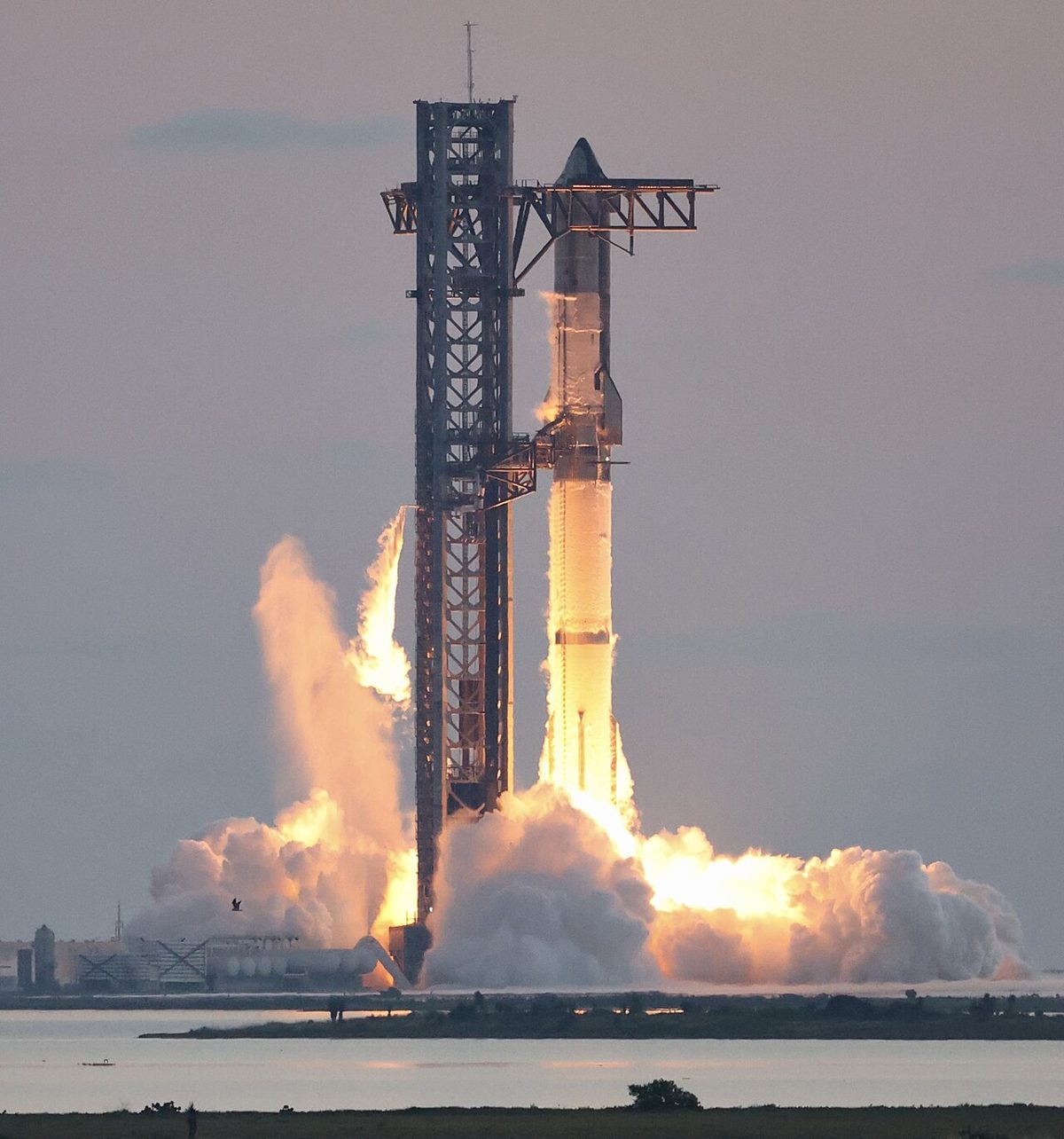

Watch: SpaceX launches Starship Flight 15, booster splashes down, from VideoFromSpace (Space.com), with SpaceX footage.
Flight 15 was built as a double-catch audition: catch the booster, then, a day later, catch the ship. The first half failed and the second half is the one still flying. According to Spaceflight Now, Starship lifted off from Starbase, Texas at 4:47 p.m. CST on Friday, November 13, the ship reached orbit and deployed 26 Starlink satellites, and the booster diverted to a fiery splashdown in the Gulf. SpaceX commentator Dan Huot explained, nearly seven hours into the mission, that the booster “aborted itself for a GNC [guidance, navigation and control] issue that it detected,” after controllers had initially been go for a catch.
Key facts
The booster: a catch that aborted itself
The flight plan called for Booster 22 to fly back to the pad about six and a half minutes after launch and be caught by the tower's arms, something three earlier boosters have done. Instead, in the later stages of its coast back, the booster detected a guidance issue and diverted itself offshore, the safest failure mode the system has. It exploded before hitting the water as remaining propellant ignited, Spaceflight Now reported. Version 3 of Super Heavy has still never made a successful return, and SpaceX has not said whether the booster was recovered or what exactly the guidance system objected to.
The ship: the harder half is still to come
No Starship upper stage has ever been caught. Ship 42 is scheduled to circle Earth about 14 times, then, if SpaceX and the ship agree everything is healthy, burn for about 10 seconds to leave orbit and fly back over Mexico and South Texas to the same tower that missed its booster. The company kept the exits open in its plan: early splashdowns off Hawaii or Chile if anything looks wrong, and a Gulf splashdown if the final approach goes bad. The attempt is expected at about 3:20 p.m. Central on Saturday, 22.5 hours after liftoff.
What happens next
Saturday afternoon is the verdict. A caught ship would complete the full-reuse demonstration Flight 15 was designed for, minus the booster; a splashdown would still leave the flight as the program's most complete mission, with an orbital ship, a full satellite deployment and a booster that failed safely. Either way, the guidance issue on Booster 22 is now the program's open question, and SpaceX's own post-flight account is the source to watch.
Sources: Spaceflight Now (the liftoff time, Huot's GNC explanation, the deployment and the Saturday return window); Motley Fool (the second-orbit framing and the 4:17 p.m. ET catch time); Florida Today (the minute-by-minute deployment and orbit entries).
Read us through Google? Add TrendBrief as a preferred source and Google will boost TrendBrief in your Top Stories when you search.