Tech · Explainer
SpaceX caught a Starship from orbit for the first time: Ship 42 came home after 14 orbits and let the tower grab it
Flight 15 was built as a double-catch audition. The booster half failed on Friday. On Saturday the ship half, the hard half, came home from orbit and let the tower catch it.

Watch: Spaceflight Now's live coverage of Starship's return for the catch attempt, from Spaceflight Now.
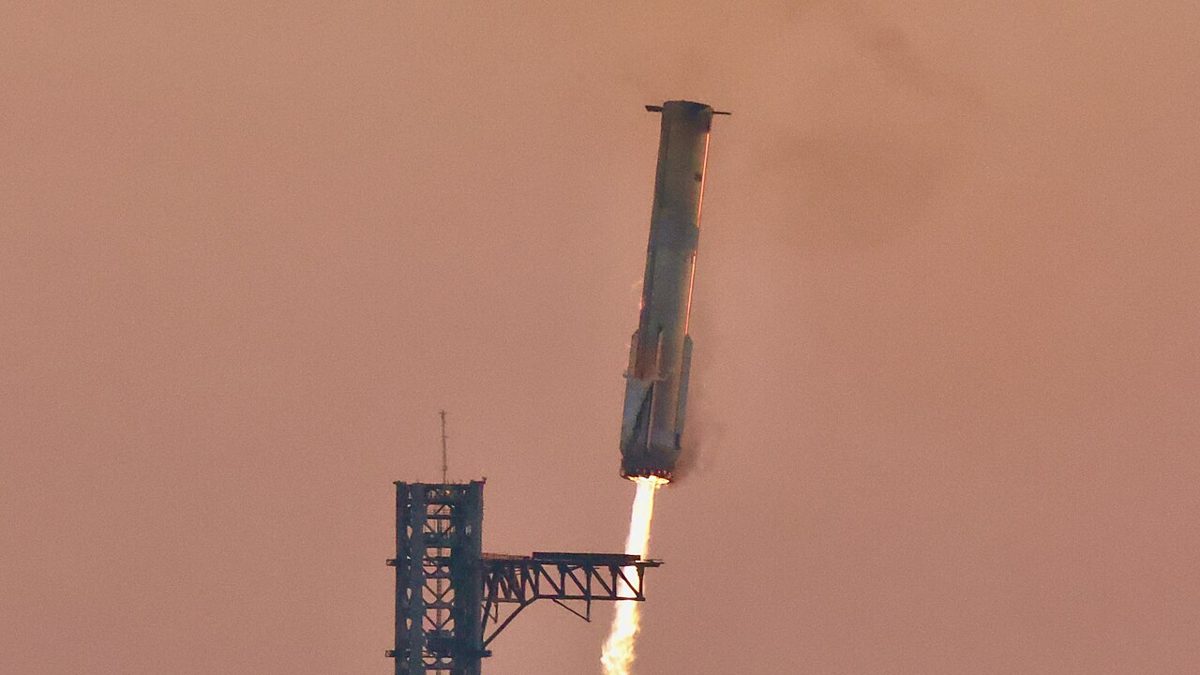
A spaceship came down out of the clouds over the south tip of Texas on Saturday afternoon, flipped itself upright on its engines, and stopped in midair between two steel arms, which held it. According to Scientific American, Ship 42 lifted off at 5:47 p.m. Eastern on Friday, November 13 from Starbase, spent nearly a full day in space circling Earth some 14 times, fired its engines just after 3:30 p.m. Eastern on Saturday to deorbit, and was caught after its final landing burn at about 4:20 p.m. Eastern (3:20 p.m. Central). SpaceX's own post was four words: "Mechazilla catches Starship!" It is the first successful catch of a Starship upper stage returning from orbit. Boosters had been caught three times before; the ship, the half that goes to orbit and will one day carry crew, never had.
Key facts
Why catching the ship is different from catching the booster
A booster comes back minutes after launch, from the edge of the atmosphere, on a path SpaceX controls the whole way. A ship comes back from orbit at about 17,500 miles per hour, sheds almost all of that speed as heat on its roughly 20,000 tiles, and has to arrive over one exact tower in Texas, upright and slow, before the arms can do anything. The tower cannot rescue a ship arriving too fast or at the wrong angle, which is why the catch is best understood as a guided powered landing onto a fixed capture mechanism, not a falling rocket being grabbed. SpaceX's business case for it is the same as the booster's: keep the heavy recovery hardware on the ground, on the reusable tower, instead of flying legs and extra structure on every ship.
The half that failed
Flight 15 was designed as the first double catch, and it will be remembered as a single. Booster 22's boostback burn ended early, its guidance decided it was not correctly positioned for a tower catch, and it diverted automatically to the Gulf of Mexico, where it was lost. Elon Musk said Sunday that a slight underperformance of engines was the reason for the diversion. That distinction matters for how the flight is scored: the abort was the safety system doing its job, and the underlying engine and fuel question is now the program's open investigation, alongside the fact that the Version 3 Super Heavy has yet to complete a successful return.
What happens next
A caught ship is the piece full reusability was missing: if Ship 42 can be inspected, refurbished and flown again, Starship stops being a rocket you throw away in halves. SpaceX president Gwynne Shotwell said last month that a recovered upper stage could fly again early next year. SpaceX has not announced a Flight 16 date, and the two questions that decide the program's pace are now concrete: what ended Booster 22's burn early, and what condition Ship 42 is actually in after 14 orbits and a tower catch. Our earlier explainer on Flight 15's launch and the lost booster covers Friday's half of the mission.
Sources: Scientific American (the catch sequence and timing, and Musk's Sunday comment); SpaceDew (the 3:20 p.m. CT catch time, the 14 orbits and the three-two-one engine sequence); The Raisina Post (the deorbit burn, the booster's low-fuel-mass warning and the recovery logic); Next News, citing Reuters and ABC News Australia (the milestone table and the Shotwell refly comment).
Read us through Google? Add TrendBrief as a preferred source and Google will boost TrendBrief in your Top Stories when you search.